
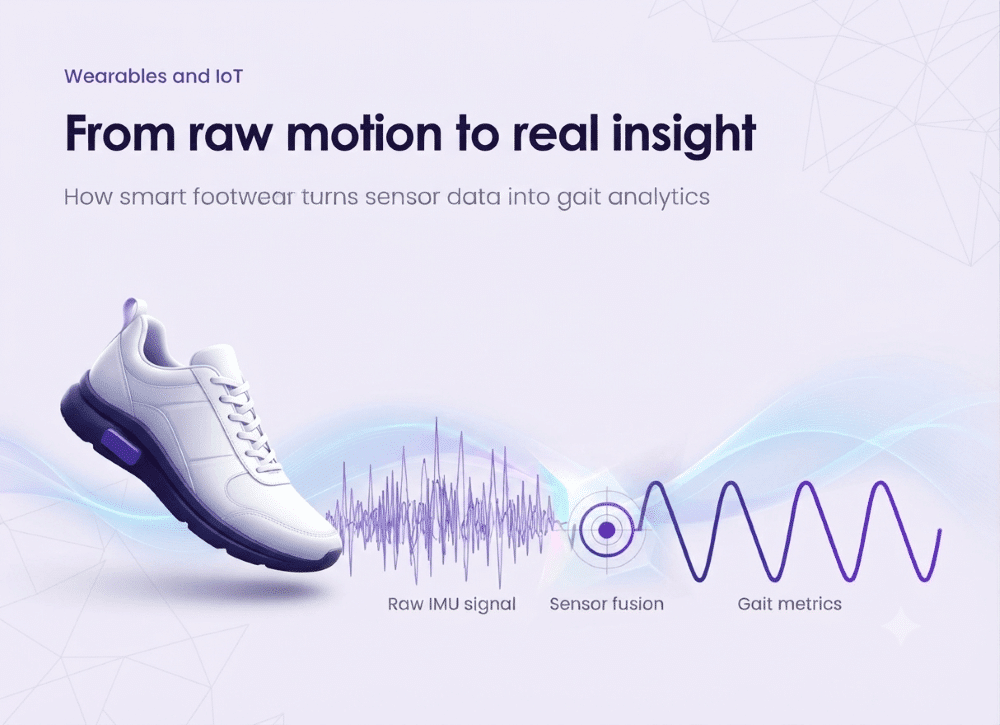
Your shoes already know a lot about you: how you walk, how you land, how you push off, and how tired you are getting. The information is there in every step. The challenge is turning it into something useful.
Wearables are moving past simple step counters toward real-time, personalized movement intelligence. This post looks at what happens between a sensor inside a shoe and an insight on your screen.
Step 1: The IMU, a Tiny Motion Recorder
Most gait-tracking wearables rely on an Inertial Measurement Unit (IMU), a small chip that typically combines:
- An accelerometer, which measures linear acceleration (how fast you speed up, slow down, or hit the ground)
- A gyroscope, which measures rotation (how the foot pitches, rolls, and twists)
- A magnetometer (in some designs), which senses orientation relative to Earth’s magnetic field
Placed in a shoe, an IMU captures a detailed record of foot movement hundreds of times per second. On its own, though, this data is noisy and hard to interpret. Raw numbers don’t say “you landed on your heel.”
Step 2: Sensor Fusion Makes Sense of the Noise
Each sensor has weaknesses. Accelerometers are affected by vibration and impact. Gyroscopes drift over time. Magnetometers can be disturbed by nearby metal and electronics.
Sensor fusion combines these signals so each one compensates for the others’ flaws. Filters such as Madgwick and Mahony are popular because they are lightweight enough for real-time use and produce a stable estimate of the foot’s orientation in 3D space.
Once you know the foot’s orientation, everything downstream becomes more reliable. Detecting a step, measuring a jump, and judging foot angle at impact all depend on this clean foundation.
Step 3: Turning Motion into Metrics
With clean, oriented data, the pipeline can start detecting events and patterns:
- Steps and cadence: identifying foot strikes and counting them reliably, even across walking, running, and stopping.
- Jumps and explosive movements: measuring take-off, flight, and landing.
- Balance and symmetry: comparing left and right foot behavior.
- Movement quality: scoring how efficient or consistent a movement pattern is over time.
This is where wearable data becomes valuable to athletes, coaches, and rehabilitation teams. A useful metric is not just a number. It is one that is repeatable, explainable, and comparable across sessions and people.
Step 4: Handling It in Real Time
Sensor data is a time series: a continuous stream of timestamped values. It is high-volume and time-sensitive, and it has to be stored and queried efficiently. A modern gait analytics pipeline usually includes:
- Ingestion: streaming data from the device (often over Bluetooth Low Energy) into the backend
- Processing: filtering, fusing, and detecting events as data arrives
- Storage: using a time-series database such as InfluxDB, built for timestamped data and fast range queries
- Serving: exposing results through APIs (for example, FastAPI services) so apps and dashboards can use them
Getting this right matters. Real-time feedback, such as “your landing was heavy on that last set”, is only useful if it arrives while the person is still moving.
Why This Matters Now
Several trends are converging:
- Cheaper, smaller sensors: make it practical to embed IMUs in everyday products
- Edge and cloud processing: let insights be generated both on-device and at scale
- Growing demand for personalization: in fitness, sports performance, and healthcare
- AI and machine learning: get better inputs when the underlying data pipeline is clean and consistent
The next wave of wearables won’t be won by whoever collects the most data. It will be won by whoever turns that data into trustworthy, actionable insight.
Challenges Worth Knowing About
Building a gait analytics system involves real trade-offs:
- Sensor placement and calibration: small differences in mounting change the readings
- Individual variation: every person walks and runs differently, so one-size-fits-all thresholds fail
- Battery vs. sampling rate: higher-resolution data drains power faster
- Data quality: dropped packets and noise must be handled gracefully
- Privacy: movement data is personal and needs to be handled responsibly
Addressing these takes collaboration between firmware, mobile, backend, and data teams, which is why gait analytics is as much an engineering-culture challenge as a technical one.
Key Takeaways
- IMUs capture rich motion data, but it only becomes useful after sensor fusion and cleaning
- Reliable metrics depend on strong event detection built on clean orientation data
- Real-time time-series pipelines are what make live feedback possible
- The value of wearable data lies in insights that people can trust and act on
Conclusion
Every step, jump, and stride is a stream of information waiting to be understood. With the right combination of sensors, fusion algorithms, and data infrastructure, smart footwear can move beyond counting steps and start explaining movement.
Want to know how this fits into the app side of connected devices? Read our two-part series, Beyond the Screen, on IoT and wearable app development.